In 1779 Zoffany was approached by London surgeon William Sharp (1729–1810) to paint a portrait of his family. The commission coincided with the artist’s return to England, and the result was one of the most ambitious and skilful group portraits of his career.
The Sharps were a talented family at the forefront of medicine, technology and social reform in eighteenth-century England. They also shared a passion for music and performed together regularly. During the warmer summer months their musical parties often took place on the River Thames on their favourite barge, the Apollo, aptly named after the Greek god of music.
William Sharp is at the top of the painting, beneath the barge’s billowing red standard. He engages the viewer and raises his hat like the captain of a ship. William wears the ‘Windsor’ livery established by George III, perhaps an allusion to his royal service as the king’s surgeon.
Below him, his wife, Catherine Barwick, wears elegant, cerulean horse-riding gear and a large black hat. She holds their daughter Mary, who in turn cradles a kitten. Mary looks fondly at her aunt Judith, another of the seven Sharp siblings, who plays an archlute, an instrument with a longer neck than a standard tenor lute and additional bass strings.
Judith’s two sisters are in the middle foreground. Frances, a fine singer, is seen in profile wearing a magnificent blue silk dress and holding a musical score. Zoffany’s dog, Poma, rests placidly at her feet. Elizabeth plays the harpsichord while their younger brother Granville holds out another music score for her to read. Granville was one of the first British people to campaign for the slave trade to be abolished. In his right hand we can see a pair of flageolets, made especially for him. On top of the harpsichord are two horns, an instrument at which William excelled, as well as a clarinet. These instruments, along with others in the painting, can today be found in the Bate Collection of Musical Instruments in Oxford.(1)
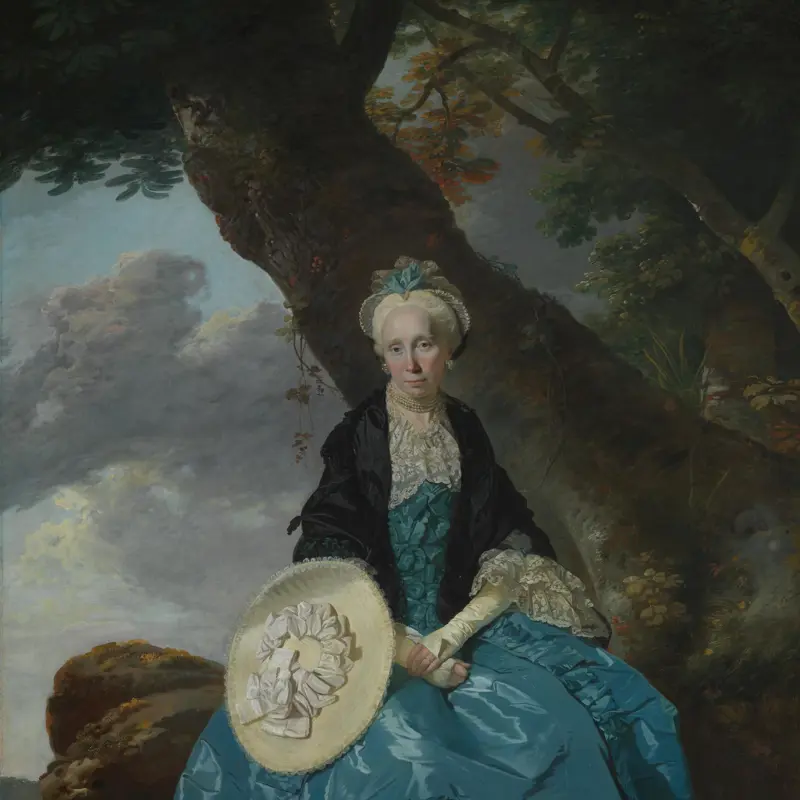
Further left stands the nine-year-old Kitty, daughter of the seated James Sharp, a highly successful manufacturer and inventor. He holds a serpent, a predecessor of the tuba, and looks towards the young cabin boy, Dick Spikeman, who stands alongside boat master William Lee on an adjacent craft. Catherine Sharp, James’s wife, is seated higher up, wearing a black shawl.
In the distance, All Saints Church in Fulham is visible. Stormy clouds threaten the musical party, but the Apollo was designed with a movable awning that could be put in place to protect the performers and their instruments during inclement weather.
In the left corner is a cello belonging to John Sharp, Archdeacon of Northumberland, who sits at the bottom right dressed in black. John’s wife is seated behind him, and their daughter Anne Jemima is at the top of the painting, wearing a rose-trimmed hat. The violin on the floor at the lower left pays poignant homage to an eighth sibling. It was played by Thomas Sharp, who died in 1772.
The work is a fine example of a conversation piece, not the representation of a specific event. The composition is a construct, a work of fiction. The sitters, for instance, would not have all posed together but instead sat for the artist individually. As a senior member of the clergy, John may not have wished to be portrayed participating, especially as such concerts often took place on Sundays. Zoffany’s dog would have hardly been invited, but signals the artist’s indirect and light-touched proximity to the upper class’s refinement.