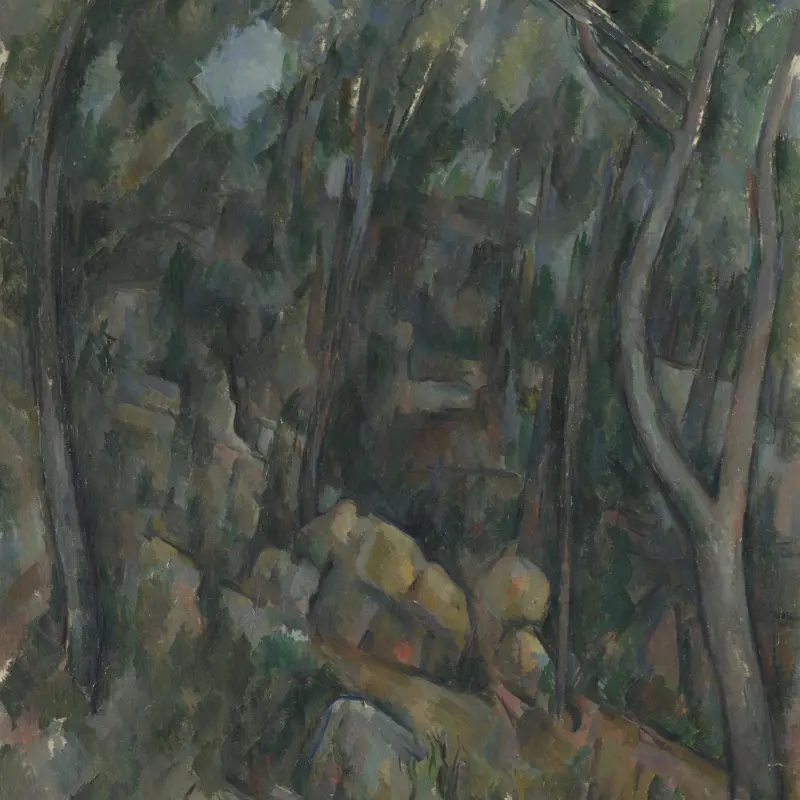
Paul Cezanne, 'In the Bibémus Quarry', 1900-04

About the work
Overview
In the mid-1890s the French artist Paul Cezanne rented a small shack on the edge of the Bibémus Quarry. This was four kilometres east of Aix-en-Provence, in the foothills of the Montagne Sainte-Victoire. Cezanne had known the area since childhood.
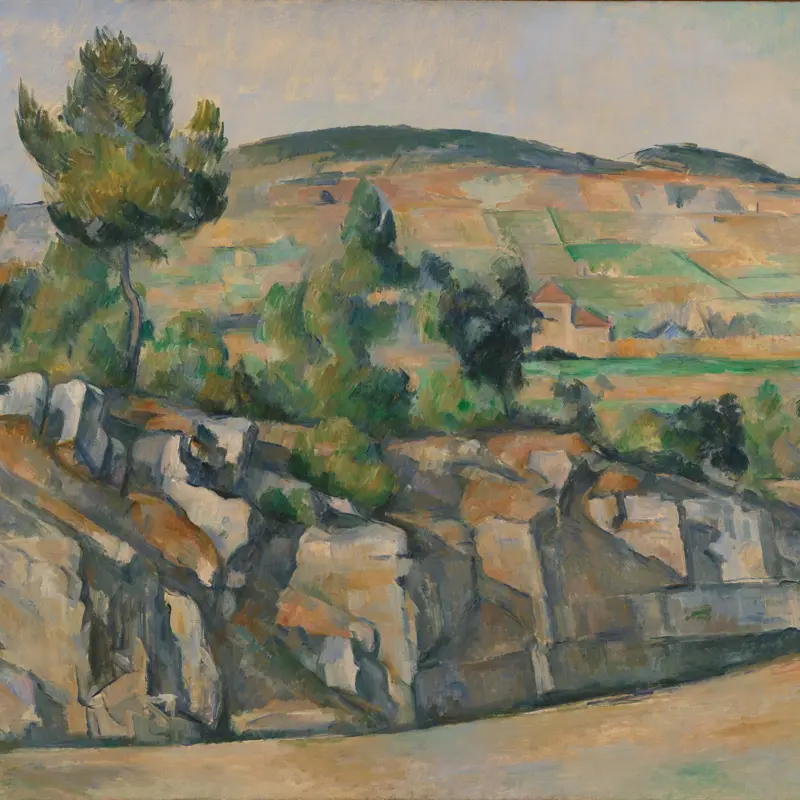
The combination of natural and manmade forms complemented Cezanne’s obsession with spatial construction and optical effects. The passages of flatness that he was developing as ways to depict the landscape around him were, at Bibémus, readily observable, as can be seen here. His vibrant paint strokes and complementary colours produced areas of both flatness and volume. These perfectly describe the quarry’s landscape. Cezanne’s amber earth tones, blues and greens were also ideal for the manmade landscape that was being reclaimed by nature.
This is the only one of his paintings of Bibémus to show a figure. It is not clear who this person is, perhaps a geologist or another visitor.
Key facts
Details
- Full title
- In the Bibémus Quarry
- Artist
- Paul Cezanne
- Artist dates
- 1839 - 1906
- Date made
- 1900-04
- Medium and support
- Oil on canvas
- Dimensions
- 79 × 63.5 cm
- Acquisition credit
- On loan from a private collection
- Inventory number
- L1330
- Location
- Room 44
- Image copyright
- On loan from a private collection, © Private Collection
- Collection
- Main Collection
About this record
If you know more about this work or have spotted an error, please contact us. Please note that exhibition histories are listed from 2009 onwards. Bibliographies may not be complete; more comprehensive information is available in the National Gallery Library.
Images
More works by Paul Cezanne