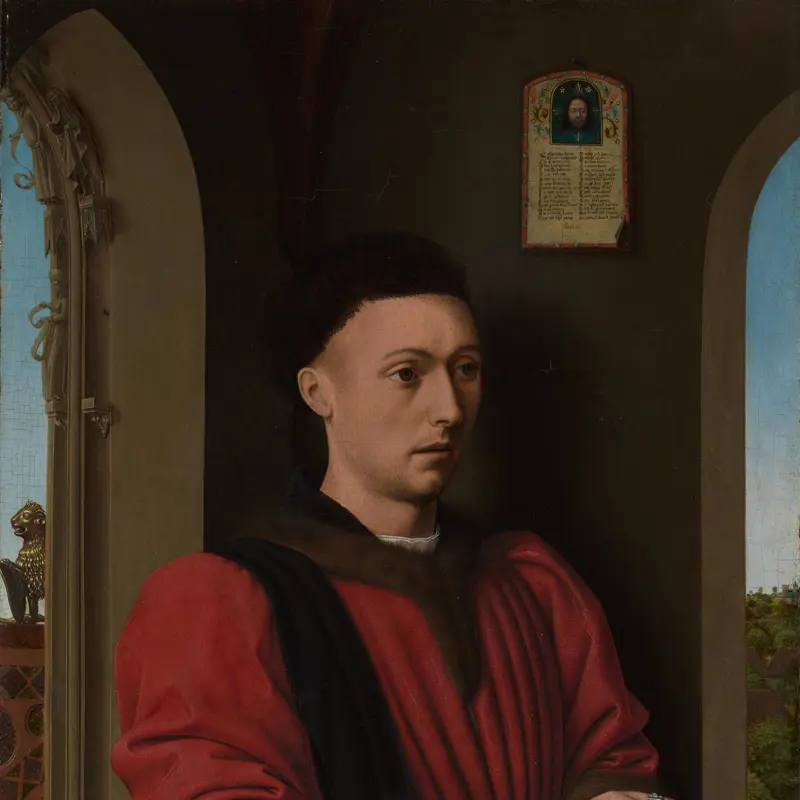
A clean-shaven man in a black hat gazes out at us from this small painting. He wears a fine brocaded green jacket over a red doublet, with an open white shirt visible at his neck. His hat is a chaperon, a fifteenth-century male headdress. It ends with a cornette, a scarf-like attachment, hanging down over his left shoulder. He has blue eyes and appears to be bald, although his temples may be shaved, as in Jan van Eyck’s Portrait of a Man (National Gallery, London). Around his neck is a heavy, interlinked gold chain, and a gold collar decorated with linked S shapes flows over his right hand, which appears to rest on the frame.
He stands in the corner of a room with a beamed ceiling and wood-panelled walls decorated with two coats of arms. The room is lit by a small circular window high up in the wall. The roof beams cast shadows on the plaster of the rear wall. The arms are those of the Grymeston family, and this is Edward Grimston (d. 1478) of Ringhales, Suffolk. He was an English diplomat serving King Henry VI, and an ambassador to the court of Philip the Good, Duke of Burgundy. In 1446 he travelled to Calais and Brussels, and probably visited Bruges, where Petrus Christus painted this portrait. The Lancastrian collar is a livery collar, showing his royal service. The linked S shapes were the symbol of the Lancastrian Kings of England. The most prestigious examples, such as this one, were made of precious metals and worn like a necklace, like the broom-pod collars in the Wilton Diptych (National Gallery, London).
On the reverse of the painting is an inscription in red and black. A heart shape is followed by PETRUS XPI. and below that ME. FECIT. A° 1446 (Petrus Christus made me, Year 1446). The heart shape covers a damaged area. The upper and lower parts of the inscription look different. Signatures on paintings in this period were not generally in the artist’s handwriting, but instead in a standard script, in either Latin or Greek letters. We find the same wording on Christus’s Portrait of a Carthusian (Metropolitan Museum of Art, New York), made in the same year. Artists usually painted signatures on the frame or in the picture space itself, however, and not on the reverse, as here. Someone probably copied this inscription from the original frame, now lost, possibly at different times.
Christus was strongly influenced by Van Eyck’s works, which he encountered when he arrived in Bruges in 1444. Taking as his model portraits such as Van Eyck’s Portrait of Jan de Leeuw (Kunsthistorisches Museum, Vienna) and his Portrait of a Man (Self Portrait?) (National Gallery, London), Christus posed the sitter at three-quarter length, filling the picture space, with his face turned at an angle and his eyes looking out at the viewer. The face is strongly lit from the right and the expression is neutral. The artist aimed to create an instantly recognisable likeness. Grimston’s long nose, hollow cheeks and thin, mobile mouth are highly distinctive. To achieve this, Christus enlarged the head and shrank the torso, and turned the nose slightly more into profile than the rest of the face.
But instead of Van Eyck’s dark, anonymous backgrounds, Christus placed the sitter in a distinct interior corner, seeming to invite us into the sitter’s personal space. This corner-space interior was a new concept for panel painting and created a very different psychological relationship with the viewer. The complex geometry of the space and the slightly oblique angle of the figure to the picture plane combine to create a sense of movement and immediacy, like a snapshot rather than a posed picture.
Christus based this composition on his highly finished Portrait of a Carthusian. He used a single model, at least for the early stages. The first version of the Carthusian’s head was the same size as Grimston’s, and the two heads match each other feature for feature. Christus spent much more time on the portrait of the monk, however, with its more finished underdrawing, nuanced lighting and meticulous detail. The original effect of the Grimston portrait is somewhat marred by its condition.
This difference in execution probably shows the circumstances of their creation. The Carthusian was presumably a local resident, available for repeated sittings, while Grimston was only temporarily in Bruges on official court business. Grimston’s head shows no sign of preparatory drawing. Christus probably sketched his likeness on paper, then used this sketch to complete the painting without further sittings. The drawing of A Man with a Falcon of around 1445–50 (Städelsches Kunstinstitut, Frankfurt am Main) shares the same corner space and tightly cropped figure. The shape of the face, with its undulating contour at the right and sweeping jawline, resembles Grimston’s portrait.