Titian, 'Portrait of a Young Man', about 1515-20
About the work
Overview
Titian captures an unknown young man with striking directness. The sitter gazes intently into the distance, with his fair skin and auburn hair catching the light. Stubble shadows his chin and upper lip, blending with the rich pink tones of his cheeks. His dark brows, hooked nose and serious expression create a compelling sense of character.
He holds a large black hat in his right hand. His left hand rests on a stone parapet, gripping a kidskin glove that he has removed in order to take off his hat. The fingernails apparent on the empty glove may be the impression of his own, or form part of the design of the glove.
The sitter’s face appears luminous against the dark background of a niche. We do not know this man’s identity, but clues surround him. The decorated column reveals a taste for classical antiquity. His rich clothes suggest wealth and status. Titian’s careful observation portrays both the sitter’s likeness and personality.
In-depth
Every detail of this young man’s face reveals Titian’s extraordinary skill. His large, pale grey eyes gaze intently into the distance. Auburn hair catches the light from the left. Stubble shadows his chin and upper lip, painted with great precision. Rich pink tones warm his cheeks. Dark, well-defined eyebrows frame his eyes and suggest deep thought. His hooked nose and unsmiling mouth create a sense of strong character.
The man is in three-quarter profile, with his body facing away from us towards his right. Our eyes are drawn to Titian’s skill at painting different textures and fabrics. He painted the black silk sleeve with broad strokes. Subtle tones create the fabric’s dense, silky surface. He used shorter, drier marks to build the red velvet sections, which capture the cut texture perfectly. The low neckline moves our eye to his pale face. The white triangle of his shirt provides a striking contrast.
In his right hand, the man holds a wide-brimmed, floppy black hat. He has clearly just removed both glove and hat. We catch him in mid-action, the hat still gripped firmly as he pauses. His left gloved hand rests on a stone parapet. This detail suggests we are seeing a real moment frozen in time. The fingernail marks in the kidskin glove may be the impressions of his own, or they could be part of the glove’s design.
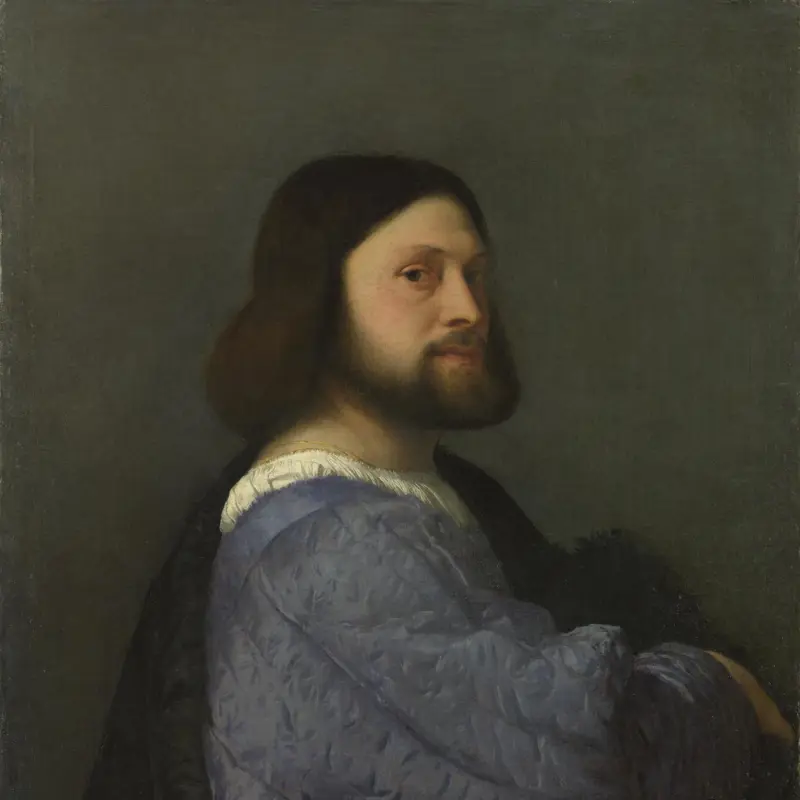
Stone parapets appear regularly in Venetian portraits from the 1400s onwards, as in Alvise Vivarini’s Portrait of a Man (National Gallery, London). The parapet separates our space from the sitter’s space, yet his gloved hand seems to reach towards us. This creates a strong physical presence.
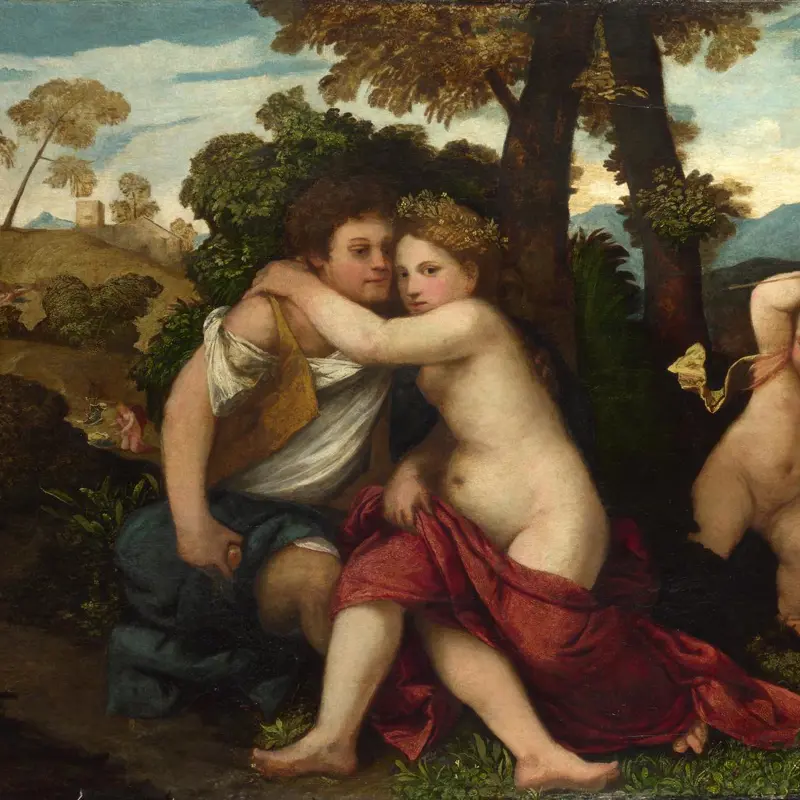
The man’s identity is unknown, but he was clearly Italian, probably from northern Italy. His face glows against the dark niche behind him. Classical relief carving on the left suggests his taste for antiquity. The carved details include vine patterns and a head with an open mouth that resembles the relief in Giovanni Cariani’s Seduction (State Hermitage Museum, St Petersburg).
Titian portrays character through physical features with remarkable skill. The sitter’s large eyes suggest deep thought. His intense gaze shows a contemplative nature. His eyebrows emphasise intelligence. His long neck implies nobility. His firm jaw shows inner strength. These details work together to create personality.
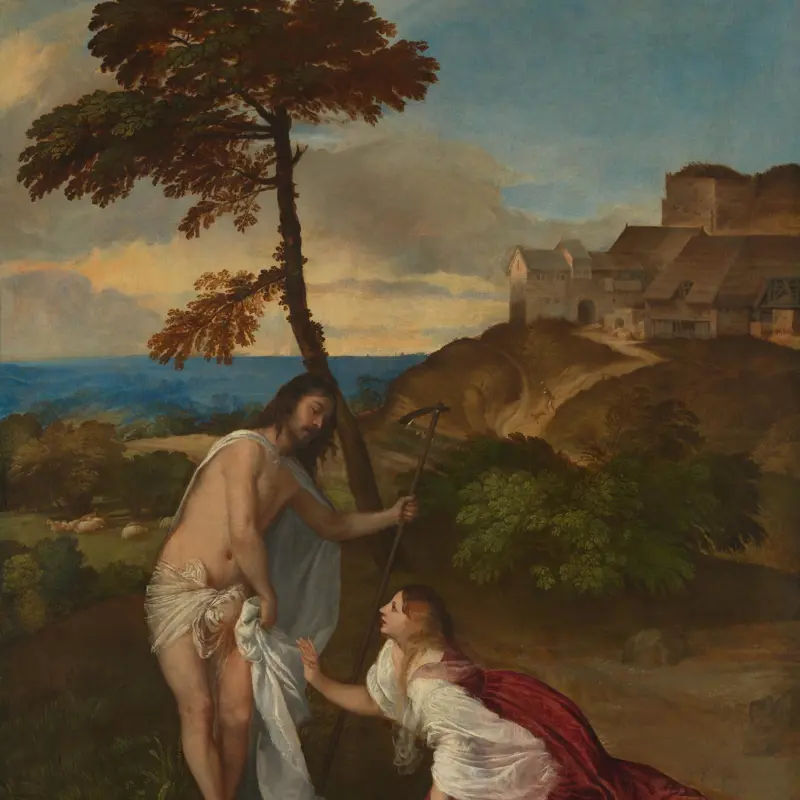
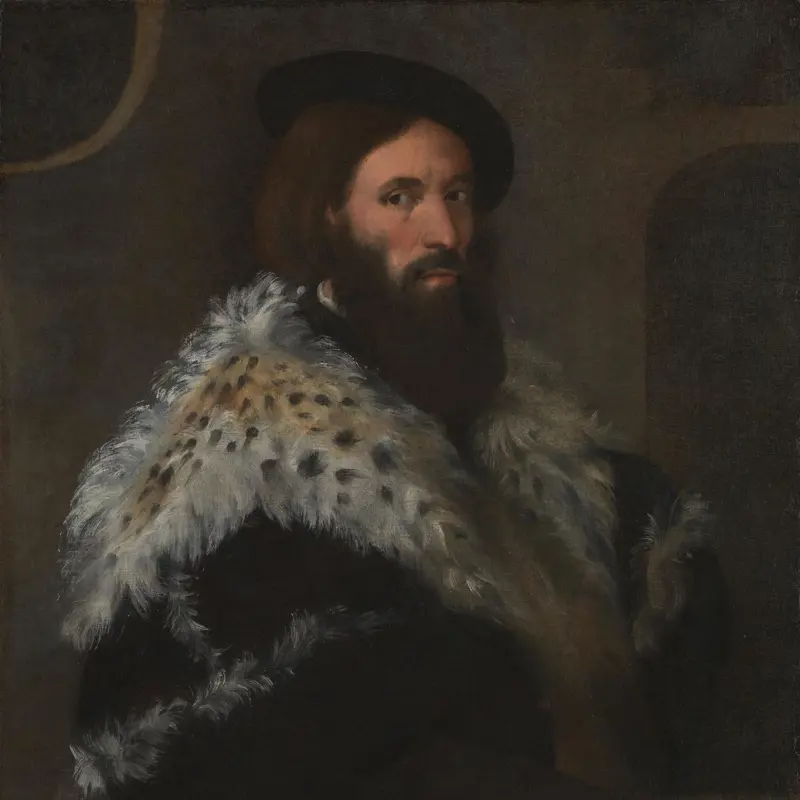
This portrait matches the format that Titian used for the Portrait of Gerolamo (?) Barbarigo (National Gallery, London). Both men pose behind stone parapets in similar positions. We see a comparable approach in Giorgione’s Portrait of a Young Man (Szépművészeti Múzeum, Budapest). The style suggests a date around 1515–20, when Titian painted the Noli me Tangere (National Gallery, London).
This careful observation of appearance and character explains Titian’s success. He became Venice’s most sought-after portraitist. He could capture not just how people looked, but who they were.
Key facts
Details
- Full title
- Portrait of a Young Man
- Artist
- Titian
- Artist dates
- Active about 1506, died 1576
- Date made
- About 1515-20
- Medium and support
- Oil on canvas
- Dimensions
- 92.7 × 70.7 cm
- Acquisition credit
- On loan from a private collection
- Inventory number
- L611
- Location
- Room 8
- Image copyright
- On loan from a private collection, © The Earl of Halifax
- Collection
- Main Collection
About this record
If you know more about this work or have spotted an error, please contact us. Please note that exhibition histories are listed from 2009 onwards. Bibliographies may not be complete; more comprehensive information is available in the National Gallery Library.